Play School Age: What Is the Right Age to Start Play School?
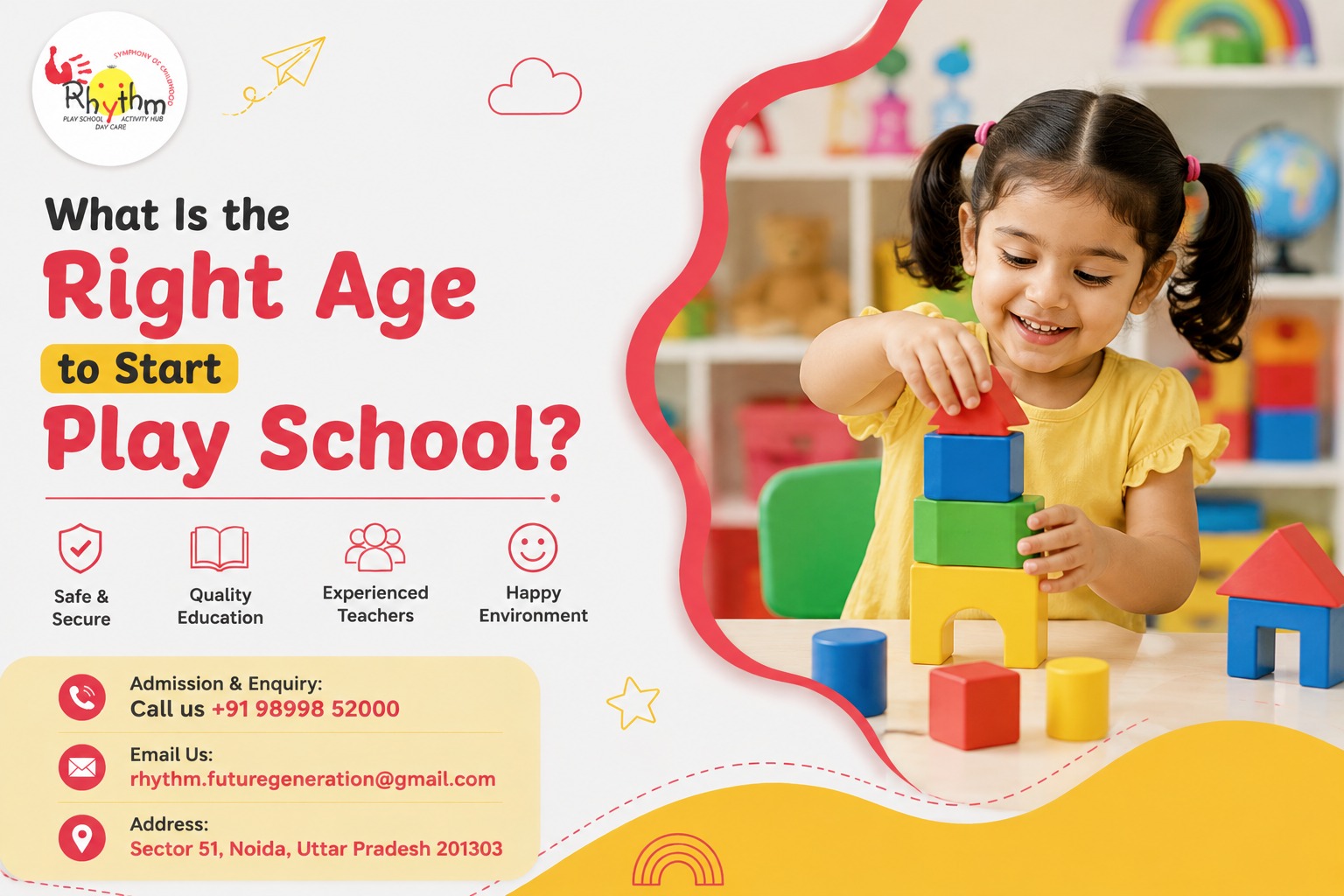
Choosing the right play school age is one of the first questions parents ask when their child is ready to start school. Many parents are not sure whether their child should start at two years, two and a half years or three years.
There is no one age that is right for every child. The suitable age depends on the child’s age, basic skills, comfort level and the program offered by the school.
In India, many children start early learning programs between 2 and 3 years of age. Some schools also offer toddler programs for children below two years. Nursery is generally started around 3 to 4 years, depending on the school’s age criteria and cut off date.
For parents looking for a play school in Noida, it is important to check both the school’s admission age and the child’s readiness.
Rhythm Play School Noida offers different early learning programs including Toddler, Playgroup, Pre Nursery, Nursery and Kindergarten. The school follows an activity based approach and uses Montessori and Playway methods along with hands-on learning. Rhythm Play School Noida
This guide explains the right play school age, age groups for different preschool classes and the things parents should check before admission.
What Is the Right Play School Age?
The right play school age can be different for every child.
Many children start a playgroup around 2 to 3 years of age. Some children may start earlier through a toddler program. Nursery usually starts around 3 to 4 years, while kindergarten generally comes after nursery.
A simple age guide is:
| Preschool Program | General Age |
|---|---|
| Toddler | Around 1.5 to 2 years |
| Playgroup | Around 2 to 3 years |
| Pre Nursery | Around 2.5 to 3.5 years |
| Nursery | Around 3 to 4 years |
| LKG | Around 4 to 5 years |
| UKG | Around 5 to 6 years |
These are general age ranges. Every school can have its own admission rules.
Parents should check the exact age criteria before filling the admission form.
What Is the Minimum Age for Play School?
There is no single minimum age followed by every preschool.
Some schools offer toddler programs from around 1.5 years. Other schools may start their first program around 2 years.
At this young age, the purpose of school is not formal academic study.
Children should get opportunities for:
- Play
- Movement
- Music
- Stories
- Sensory activities
- Simple art
- Social interaction
- Basic communication
The child should feel safe and comfortable.
Parents should not feel that their child must start school as early as possible.
The right time is when the child and the family are ready for the change.
What Is the Common Play School Age in India?
In India, preschool programs are generally divided into different stages according to the child’s age.
A child may start with a toddler program and then move to playgroup, pre nursery, nursery and kindergarten.
The names and age groups can differ between schools.
For this reason, parents should not compare only the names of classes.
For example, one school may call a class Playgroup while another may use Pre Nursery for a similar age.
The important things to check are:
- Age criteria
- Cut off date
- Class level
- Daily timings
- Curriculum
- Learning activities
- Child readiness
Play School Age at Rhythm Play School Noida
Rhythm Play School Admission Programs for different stages of early childhood.
Its admission information currently lists the following general age groups:
- Toddler Program
- Playgroup
- Pre Nursery
- Nursery
- Kindergarten
The school’s admission page lists the Toddler Program around 1.5 to 2 years, Playgroup around 2 to 3 years, Pre Nursery around 2.5 to 3.5 years, Nursery around 3 to 4 years and Kindergarten around 4 to 5 years.
The individual program pages may show slightly different age descriptions. Parents should therefore confirm the current age criteria with the school before admission.
Toddler Age for Play School
The toddler stage is for very young children who are starting their first group learning experience.
At this stage, children need more care and simple activities.
The focus can be on:
- Sensory play
- Music
- Rhymes
- Movement
- Picture books
- Toys
- Simple games
- Motor activities
- Basic communication
Rhythm Play School describes its Toddler Program as focusing on sensory and motor development along with early social skills.
Is 1.5 Years Too Early for Play School?
Not necessarily.
Some children can adjust to a short early learning program around this age.
However, parents should understand that a child of 1.5 years may still need a lot of support.
The child may:
- Cry when parents leave
- Need help with food
- Need help with the washroom
- Take time to interact with teachers
- Prefer individual play
- Need frequent breaks
This is normal at this age.
The school should have teachers and support staff who understand the needs of very young children.
Playgroup Age
Playgroup is commonly started around 2 to 3 years.
At this stage, children start learning how to participate in a group.
Rhythm Play School lists its Playgroup program for young children and includes activities such as structured play, music, art and guided activities.
A Playgroup program can include:
- Rhymes
- Music
- Stories
- Drawing
- Colouring
- Simple games
- Blocks
- Outdoor play
- Basic counting
- Colour recognition
- Shape recognition
The main focus should still be on learning through play.
What Should a Two Year Old Learn in Playgroup?
A two year old does not need a heavy academic curriculum.
The child can start learning simple concepts.
For example:
- Red and blue
- Big and small
- One and two
- Circle and square
- Up and down
- Happy and sad
Teachers can introduce these concepts through toys, songs, stories and activities.
Pre Nursery Age
Pre Nursery is usually for children around 2.5 to 3.5 years, depending on the school.
At this stage, children can slowly move towards more structured activities.
Rhythm Play School lists a Pre Nursery program for young children and describes the use of hands-on activities, storytelling and interactive play.
Children may learn:
- New words
- Basic counting
- Colours
- Shapes
- Simple patterns
- Rhymes
- Stories
- Art
- Music
- Group activities
- Basic self help skills
Why Is Pre Nursery Important?
Pre Nursery helps children become more comfortable with a school routine.
They start understanding:
- When to play
- When to listen
- When to eat
- When to clean up
- How to share
- How to wait for their turn
These simple habits can help them in nursery and later classes.
Nursery Admission Age
Nursery is generally for children around 3 to 4 years.
However, the exact age can be different between schools.
Rhythm Play School currently lists Nursery from around 3.5 years onwards in its program information.
Nursery children can start learning more structured concepts while still getting enough time for play.
The curriculum may include:
- Alphabet
- Phonics
- Numbers
- Counting
- Colours
- Shapes
- Stories
- Rhymes
- Drawing
- Art and craft
- Music
- Outdoor activities
Parents looking for nursery admission in Noida should check the age cut off date of the school before applying.
What Is the Right Age for LKG?
LKG generally starts around 4 years of age.
The exact age depends on the school’s admission rules.
At this stage, children may start working on:
- Phonics
- Letter recognition
- Writing readiness
- Number concepts
- Simple addition
- Shapes
- Patterns
- Reading readiness
- General awareness
The child should still have time for play and creative activities.
What Is the Right Age for UKG?
UKG generally starts around 5 years.
It comes after LKG and before Class 1 in many school systems.
Children at this stage may work on:
- Reading
- Writing
- Phonics
- Numbers
- Basic maths
- General awareness
- Storytelling
- Creative activities
- Problem solving
The exact admission age should always be checked with the school.
How to Know If Your Child Is Ready for Play School?
Age is important but it is not the only thing parents should consider.
A child may meet the school’s age criteria but still need some time to become comfortable with a school environment.
Look for simple signs of readiness.
Your Child Can Stay With Another Adult
If your child can stay with grandparents or another trusted adult for some time, it may be easier to adjust to school.
The child does not need to stay away from parents for many hours.
Your Child Can Follow Simple Instructions
The child should slowly understand simple instructions.
For example:
“Come here.”
“Keep the toy here.”
“Sit down.”
“Give me the ball.”
The child does not need to follow every instruction perfectly.
Your Child Can Communicate Basic Needs
It is helpful if the child can communicate basic needs.
For example:
- I want water
- I want food
- I need help
- I want to go to the washroom
- I am feeling tired
This makes it easier for teachers to understand the child.
Your Child Shows Interest in Other Children
If your child likes watching or playing around other children, group activities may become easier.
The child may still need time to share and take turns.
That is normal.
Your Child Can Follow a Simple Routine
A basic routine at home can help the child adjust to school.
For example:
- Wake up
- Breakfast
- Play
- Lunch
- Rest
- Outdoor activity
- Sleep
The school will have its own routine, but children who are already comfortable with a daily routine may adjust more easily.
Does a Child Need to Know ABC Before Play School?
No.
Children join preschool to start learning.
Parents do not need to teach the complete alphabet before admission.
You can introduce letters at home through:
- Picture books
- Alphabet cards
- Songs
- Toys
- Simple games
But there should not be pressure to memorise everything.
Does a Child Need to Know Numbers Before Admission?
No.
Basic number concepts can be introduced at home through everyday activities.
You can ask your child to count:
- Toys
- Fruits
- Blocks
- Spoons
- Cars
This can make numbers easy and interesting.
Play School Age and Child Development
Children of the same age can have different skills.
One three year old may speak very well.
Another may be quieter.
One child may enjoy group activities.
Another may take more time to join.
This is normal.
Parents should avoid comparing their child with other children.
A good preschool should give children time to develop according to their own pace.
Why Starting at the Right Age Matters
Starting school at a suitable age can make the transition easier.
If a child is too young for a particular program, the child may find the activities difficult.
If the child is much older than the other children, the activities may not be challenging enough.
This is why schools divide children into age based programs.
Age appropriate learning can help children enjoy school and learn better.
Play School Age and Social Development
Preschool is one of the first places where children regularly interact with a larger group of children.
They start learning social habits.
For example:
- Sharing
- Taking turns
- Listening
- Helping
- Waiting
- Making friends
- Saying sorry
- Saying thank you
These skills cannot be learned only from books.
Children need real situations to practise them.
Play School Age and Language Development
Young children develop language through regular communication.
A preschool can provide many opportunities for this.
Teachers can use:
- Stories
- Songs
- Rhymes
- Picture books
- Conversations
- Role play
Children can learn new words and slowly become more confident while speaking.
Parents can continue this at home by talking with the child about daily activities.
Play School Age and Physical Development
Children need physical movement every day.
A preschool curriculum should include activities that allow children to move.
These can include:
- Running
- Jumping
- Ball games
- Balancing
- Climbing
- Simple exercises
These activities can support coordination and body control.
Play School Age and Creative Learning
Creativity is another important part of preschool learning.
Children can explore their ideas through:
- Drawing
- Painting
- Colouring
- Clay
- Paper craft
- Music
- Dance
There is no need for every child to make the same picture.
The focus should be on exploring and trying.
What Should Parents Check Before Admission?
Once you understand the play school age, the next step is to check the school.
Do not choose a preschool only because it accepts your child’s age.
Look at the complete environment.
Check the School Safety
Ask about:
- CCTV
- Entry and exit
- Child pickup
- Emergency procedures
- Teacher supervision
- Outdoor safety
Rhythm Play School mentions CCTV access and a secured environment among its facilities.
Check the Classroom
During the visit, see whether:
- Classrooms are clean
- Furniture is child friendly
- Learning material is available
- Children have enough space
- Teachers interact with children
Check the Play Area
Young children need enough opportunity for physical play.
Ask how often children use the play area.
Check the Teachers
Talk to the teachers if possible.
Ask how they help children who cry or take time to adjust.
Check the Class Size
Ask how many children are in one class and how many teachers or support staff are available.
This is important for young children.
What Is a Good Play School Curriculum?
A good play school curriculum should cover different areas of child development.
It should not be only about writing and worksheets.
The curriculum can include:
Language
- Stories
- Rhymes
- Conversation
- Picture reading
- Vocabulary
Early Maths
- Counting
- Numbers
- Shapes
- Colours
- Matching
- Sorting
Creative Activities
- Drawing
- Painting
- Craft
- Music
- Dance
Physical Activities
- Outdoor games
- Movement
- Running
- Jumping
- Ball activities
Social Skills
- Sharing
- Taking turns
- Helping
- Group activities
Montessori and Playway Learning
Parents may come across terms like Montessori and Playway while searching for a preschool.
Rhythm Play School describes its teaching approach as a blend of Montessori and Playway methods. The school also mentions hands-on and activity based learning.
Parents should ask how the method is used in the classroom.
A teaching method should help children understand concepts through activities and practical experiences.
Should Parents Choose a Play School Based Only on Fees?
No.
Play school fees are important but they should not be the only factor.
Parents should compare:
- Fees
- Safety
- Teachers
- Curriculum
- Activities
- Location
- Timings
- Daycare
- Transport
A school with a lower fee may not always offer the services your family needs.
Similarly, a higher fee does not automatically mean better education.
Ask for the complete fee structure and understand what is included.
How Far Should a Play School Be From Home?
Distance is another factor worth checking.
Young children may get tired if they spend a lot of time travelling every day.
A nearby school can make the daily routine easier.
Parents should check the actual travel time during school hours.
If transport is required, ask about the route and safety arrangements.
Should Parents Visit the School Before Admission?
Yes.
A school visit is one of the best ways to understand whether the preschool is suitable for your child.
During the visit:
- Observe the classrooms
- Meet the teachers
- Check the play area
- Ask about safety
- Understand the curriculum
- Ask about timings
- Check fees
- Ask about transport
- Ask about daycare
Do not hesitate to ask questions.
How to Prepare Your Child for Play School
Once you decide the right play school age, you can start preparing your child at home.
Start a Daily Routine
Keep regular timings for sleeping, eating and playing.
Teach Simple Self Help Skills
Let your child slowly learn to:
- Wash hands
- Eat with a spoon
- Drink water
- Keep toys back
- Wear shoes
- Carry a small bag
Spend Time Reading
Read picture books with your child.
Ask simple questions about the pictures.
Encourage Communication
Talk with your child regularly.
Ask about toys, colours, animals and daily activities.
Let the Child Play
Do not turn every activity into study time.
Free play is also learning.
What Parents Should Not Do Before Preschool
Parents should avoid putting too much pressure on young children.
Do not force the child to:
- Write long pages
- Memorise too many poems
- Learn difficult maths
- Read long words
- Sit for many hours
The child is still developing.
The aim of preschool should be to build interest in learning.
Common Mistakes Parents Make About Play School Age
Starting Too Early Because Other Children Have Started
Every child is different.
Do not start only because another child has joined school.
Waiting Only for Academic Skills
A child does not need to read or write before joining preschool.
Ignoring the School’s Cut Off Date
The child’s age should be checked according to the school’s admission rules.
Choosing a Class Only by Name
Playgroup and Pre Nursery can have different meanings in different schools.
Check the actual age group and curriculum.
Comparing Children
Do not compare your child’s development with another child.
Choosing Only on Fees
Look at safety, teachers, curriculum and daily routine too.
Play School Age vs Nursery Admission Age
Play school is a broad term for early childhood education.
Nursery is generally a particular preschool class.
A child may start with:
Toddler → Playgroup → Pre Nursery → Nursery → Kindergarten
But not every school follows the same sequence.
Some children may directly join nursery if they meet the age criteria.
Parents should check the school’s admission rules.
Play School Age for Working Parents
Working parents may have additional requirements.
They may need:
- Longer school timings
- Daycare
- Transport
- Meals
- Extended care
If you need these services, ask about them before admission.
Rhythm Play School Noida also lists daycare as one of its services. Parents should confirm the current daycare timings, age criteria and fees directly with the school.
Questions Parents Should Ask About Play School Age
Before admission, ask the school:
What is the minimum admission age?
This helps you understand which program your child can join.
What is the age cut off date?
Ask how the school calculates age.
Which class is suitable for my child?
Give the child’s date of birth and ask the admission team.
Can my child directly join nursery?
Ask if previous preschool experience is required.
What if my child’s birthday is close to the cut off date?
The school can explain the applicable rule.
Can I visit the school before admission?
A school visit is useful for understanding the environment.
Final Words
The right play school age depends on more than just the child’s birthday.
Parents should check the school’s age criteria and also look at the child’s readiness. A young child should be able to slowly adjust to a new routine, interact with teachers and children and take part in simple activities.
For many children, play school starts around 2 to 3 years. Nursery commonly starts around 3 to 4 years, followed by kindergarten. However, the exact age can be different from one school to another.
Parents looking for a best play school in Noida should compare schools based on safety, teachers, curriculum, activities, fees, location and the overall environment.
Rhythm Play School Noida offers different early learning programs for different age groups. Its approach includes Montessori and Playway methods along with hands-on activities. Parents can visit the school and speak with the admission team to understand the suitable program for their child.
The most important thing is to make the first school experience comfortable and enjoyable.
Children should feel safe.
They should get time to play.
They should be encouraged to ask questions.
They should get opportunities to talk, create and explore.
When the school environment matches the child’s age and needs, starting preschool can become a positive first step towards formal education.
Quick Parent Checklist
- Check your child’s current age
- Check the school’s age cut off date
- Ask which program suits your child
- Visit the school
- Meet the teachers
- Check classroom size
- Understand the curriculum
- Ask about outdoor play
- Check safety arrangements
- Ask about school timings
- Check play school fees
- Ask about transport
- Ask about daycare if required
- Keep admission documents ready
- Talk positively about school with your child
Frequently Asked Questions About Play School Age
What is the best age to start play school?
Many children start play school around 2 to 3 years. Some schools offer toddler programs from around 1.5 years. The right age depends on the child and the school’s admission rules.
Is 2 years a good age for play school?
Yes, many children can start a suitable playgroup around two years. Parents should also consider the child’s readiness and comfort.
Is 3 years too late to start play school?
No. Three years is a common age for preschool and nursery programs. A child can start at this age if the school accepts the child.
What is the nursery admission age?
Nursery is commonly around 3 to 4 years, but the exact age can differ. Parents should check the school’s current age criteria.
What is the playgroup age?
Playgroup is commonly around 2 to 3 years. The exact age depends on the school.
What is the Pre Nursery age?
Pre Nursery is commonly around 2.5 to 3.5 years, depending on the school.
What is the kindergarten admission age?
Kindergarten is generally around 4 to 5 years for the first kindergarten level. The exact criteria depend on the school.
Can my child join nursery directly?
Yes, many schools allow children to join nursery directly if they meet the required age and admission conditions.
Does a child need to be toilet trained before play school?
This depends on the child’s age and school policy. Parents should ask the school about its washroom support and toilet training policy.
Does my child need to know ABC before joining play school?
No. Preschool is where children start learning basic letters, sounds and other concepts.
Does my child need to know numbers before joining preschool?
No. Basic counting and number concepts can be introduced after the child joins the preschool.
How do I know if my child is ready for play school?
Look for simple signs such as being able to follow basic instructions, communicate basic needs, interact with others and stay with a trusted adult for some time.
What should I check besides play school age?
Check the school’s safety, teachers, curriculum, class size, activities, fees, location, timings and daycare options.
What is the play school age at Rhythm Play School Noida?
Rhythm Play School lists different age groups for its Toddler, Playgroup, Pre Nursery, Nursery and Kindergarten programs. Parents should confirm the exact age requirement for the current admission session directly with the school.
What learning method does Rhythm Play School follow?
Rhythm Play School says that it uses a blend of Montessori and Playway methods with hands-on and activity based learning.